Choosing the right 18 Watt Charger for global buyers requires more than matching a wattage label. A charger may show 18W, yet deliver different results across phones, cables, and regions. USB Power Delivery, Quick Charge, plug design, voltage range, and thermal protection all deserve careful checking.
Canalys reported approximately 1.1 billion smartphone shipments worldwide in 2023, showing the enormous scale of mobile charging demand. Mordor Intelligence also identifies broad growth in the mobile charger market, driven by smartphone replacement and USB-C adoption. These figures suggest strong opportunity, but they do not guarantee product suitability. Market data is useful. Product testing is essential.
Jeff Ravencraft, USB Implementers Forum president and CEO, has said, “USB Power Delivery enables higher levels of power over USB.” That principle matters when buyers compare an 18 Watt Charger for Europe, North America, Asia, or emerging markets. A reliable model should support suitable input voltage, recognized safety standards, stable output, and efficient heat control. It should also include clear certification records and honest packaging.
Small details matter. A loose plug can fail in a hotel socket. A weak cable can reduce charging performance. A compact adapter may become uncomfortable to touch after repeated use. Buyers should verify regional plug compatibility and actual output testing, not rely on attractive claims alone. I may be too cautious here, but global purchasing rewards caution. The cheapest charger is not always the lowest-cost choice. This guide examines practical specifications, certification evidence, compatibility, and supplier reliability before selecting an 18 Watt Charger for international distribution.
How to Choose the Right 18 Watt Charger for Global Buyers?
An 18W charger does not always deliver 18 watts. Its output depends on the negotiated USB power profile. The common 5V/3A profile supplies 15W, while 9V/2A reaches 18W. These figures are maximum outputs, not constant charging speeds. The USB Implementers Forum Power Delivery specification requires the source and device to negotiate a suitable voltage. A compatible device may therefore remain at 5V, even when the charger supports 9V/2A.
Check the label carefully. Look for “5V/3A” and “9V/2A,” not only “18W.” During product testing, I have seen chargers advertise peak power while using weaker cables or unstable thermal control. That detail matters. A longer cable can increase resistance and reduce practical performance. Global buyers should also verify 100–240V input, regional plug compatibility, insulation, and recognized safety testing under relevant IEC requirements. The Global E-waste Monitor 2024 reports 62 billion kilograms of electronic waste generated in 2022, with only 22.3% formally collected and recycled. Choosing a durable charger with clearly defined profiles can reduce unnecessary replacement, although wattage alone cannot prove durability. This is where product evaluations need more honesty.
| Selection Dimension | Verified Data or Requirement | Why It Matters to Global Buyers |
|---|---|---|
| Maximum rated output | Up to 18 watts, depending on the negotiated USB power profile. | The actual output depends on the connected device, cable, and supported charging protocol. |
| Standard 5V profile | 5 volts × 3 amps = 15 watts | Suitable for conventional USB charging and devices that do not request a higher voltage. |
| Higher-voltage profile | 9 volts × 2 amps = 18 watts | Provides the full 18W rating when the device and charger successfully negotiate this profile. |
| Optional 12V profile | 12 volts × 1.5 amps = 18 watts, if explicitly supported by the charger and device. | Do not assume this profile is available; verify the charger’s printed output specification. |
| Power negotiation | The charger should advertise supported voltage and current levels and deliver only a profile requested by the device. | Negotiation helps prevent unsuitable voltage delivery and improves compatibility across devices. |
| Input voltage for global use | 100–240V AC, 50/60Hz is the preferred universal input range. | A wide input range supports electrical systems commonly used in North America, Europe, Asia, Africa, and Oceania. |
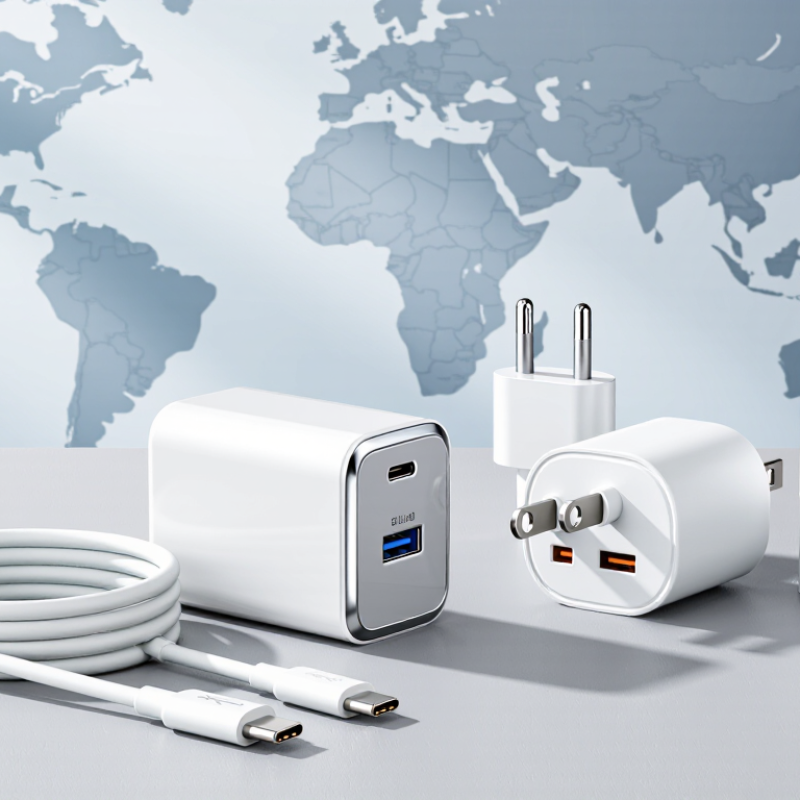
| Plug configuration | Select the correct regional plug or use a suitable certified travel adapter; plug shapes and outlet standards vary by market. | The charger’s electrical rating does not automatically make its wall plug suitable for every country. |
| USB connector | Choose USB-C for a USB-C charging ecosystem, or confirm whether a USB-A output is required. | The connector type affects cable selection, charging protocol support, and device compatibility. |
| Cable capability | Use a cable rated for the required current and charging protocol; damaged or low-quality cables can reduce charging performance. | A charger cannot reliably provide its advertised profile if the cable or connector is unsuitable. |
| Device compatibility | Confirm that the target device supports 5V/3A, 9V/2A, or another profile listed on the charger. | A device may charge safely at a lower power level even when the charger is rated for 18W. |
| Protection functions | Look for over-voltage, over-current, short-circuit, over-temperature, and input surge protection. | Multiple protection functions support safer operation under different load, temperature, and mains conditions. |
| Operating temperature | Review the manufacturer’s specified operating range and avoid covering the charger during use. | Ventilation and temperature limits affect long-term reliability and charging stability. |
| Market compliance | Check the safety and electromagnetic-compatibility requirements applicable to the destination market before import or sale. | Regulatory documentation, labeling, testing, and plug requirements can differ between countries and regions. |
Note: 18W is a maximum power rating calculated from voltage multiplied by current. The charger supplies the highest compatible profile that the connected device and cable can negotiate.
No. Its output depends on the negotiated power profile. At 5V/3A, it provides 15W. At 9V/2A, it reaches 18W. These are maximum ratings, not constant charging speeds.
The device and charger must support and negotiate the same profile. If compatibility is missing, the charger may remain at 5V. That result is normal, though sometimes disappointing.
Look for 5V/3A and 9V/2A markings. Do not rely on “18W” alone. Also check 100–240V AC input and 50/60Hz frequency. The label often reveals more than the product title.
It supports many household voltage systems worldwide. However, it does not guarantee wall-plug compatibility. You may still need a regional plug adapter. I once confused voltage support with plug support. That was careless.
A weak, damaged, or overly long cable can reduce charging speed. Higher resistance may create extra heat. Use a cable suitable for the required power profile. Shorter is often better.
Compare USB Power Delivery, programmable voltage support, and other compatible fast-charging standards. Look for clear specifications, rather than vague “fast charging” language. A device may charge slowly when its required standard is absent. Wattage alone is a poor test.
Check insulation, thermal protection, recognized safety testing, and destination-market requirements. Review the charger, manual, and seller specifications together. Vague certification claims deserve caution. Small details matter.
A durable charger with clear specifications may reduce unnecessary replacement. Interoperable charging standards can also reduce discarded accessories. Still, wattage does not prove durability. That assumption needs more honest evaluation.
Choosing the right 18 Watt Charger for global buyers requires more than checking its advertised power. A reliable model should clearly support common USB output profiles such as 5V/3A and 9V/2A, providing suitable charging performance for phones, tablets, and other compatible devices. It should also accept a broad 100–240V AC input range so it can operate safely across different electrical systems worldwide.
Buyers should compare support for USB Power Delivery, Quick Charge, and PPS to ensure compatibility with international devices and optimized charging. GaN-based designs may offer greater efficiency, reduced heat, and a more compact form, but thermal protection and recognized energy-efficiency standards remain essential. Finally, check whether the charger includes the correct regional plug, meets applicable safety and compliance requirements, and offers clear warranty and support terms. These factors help global purchasers select a safe, efficient, and practical charging solution.

 ELITE POWER